
St. Clair County Probate Matters
The St. Clair County Probate Court handles wills and estate administration. A typical estate record may contain a petition or application, the will, letters testamentary or letters of administration, a bond, inventory, creditor notice, accountings, court orders, and a final settlement. These filings show who asked to administer an estate, what authority the Probate Court granted, and how the matter moved toward closing. A will on its own is only one part of the file. The docket and orders show what the Probate Court actually did.
Guardianships and conservatorships also pass through the St. Clair County Probate Office. A guardian receives authority over personal care, while a conservator receives authority over finances or property. These cases can concern minors or adults who cannot manage some affairs. They may contain protected medical, financial, or family details, so access can be narrower than access to an ordinary estate. The Probate Office also performs recording functions, handles notary-related matters, and records Alabama marriage certificates. It does not replace the Circuit Clerk for Circuit or District Court files.
Estate administration can continue through several stages. A petition opens the matter, and the Probate Court may issue letters that prove the representative's authority. Notice to creditors gives claims a route into the estate. An inventory can identify property under administration, while later accountings track receipts, expenses, and distributions. A final settlement or closing order shows that the court accepted the last accounting or otherwise ended the proceeding. The order, not a family member's assumption, establishes the authority shown in the official St. Clair County probate record.
The official St. Clair County Probate Office profile identifies the office and its two branches. The captured office view below helps users recognize the correct county source. It also distinguishes Probate Court work from state trial-court records.
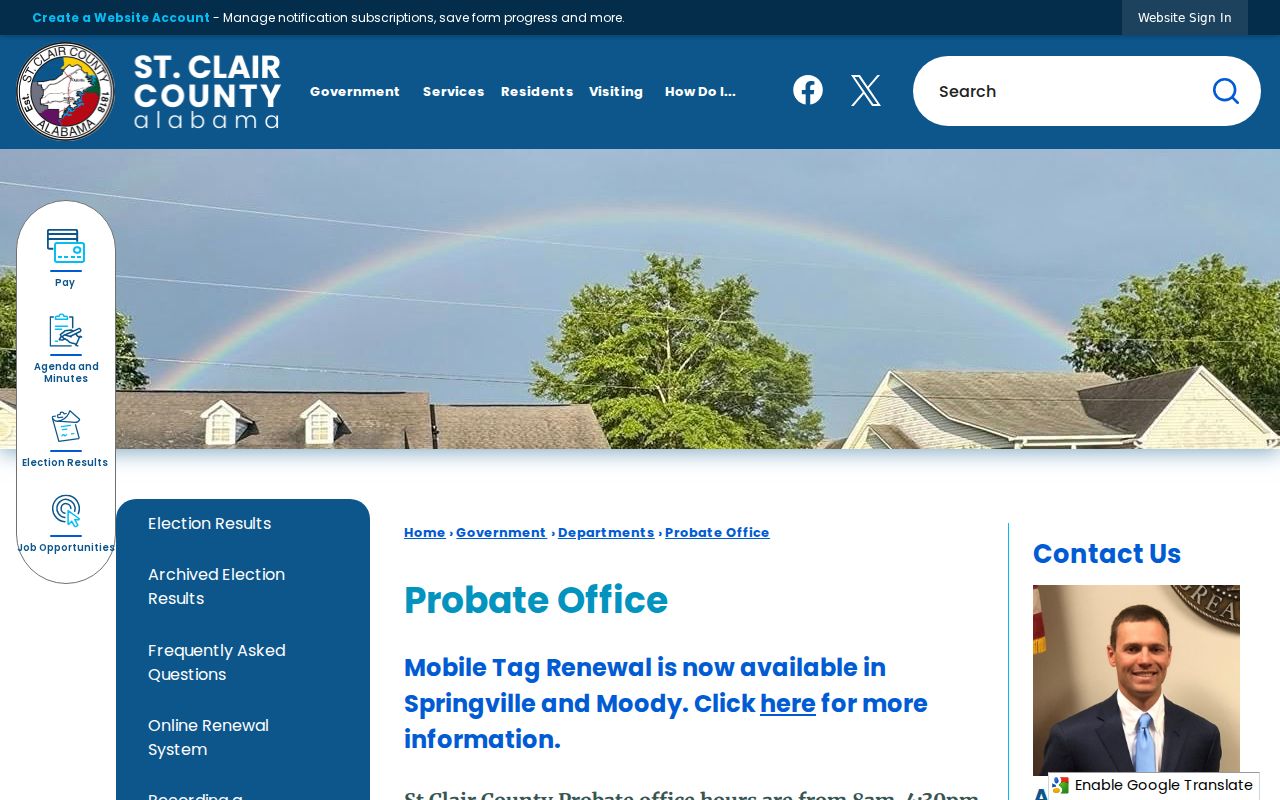
That county source is the best starting point for current office contacts, payment notes, and marriage-certificate guidance.
St. Clair Probate Terms
Probate Court records use terms that describe the deceased person, the person placed in charge, and the type of authority granted. Reading those terms first makes an estate or protective case file much easier to follow.
- Testator
- The person who made and signed a will.
- Executor
- The person named in a will to carry out its terms, subject to Probate Court authority.
- Intestate
- The condition of dying without a valid will.
- Guardianship
- Probate Court authority concerning a protected person's personal care.
- Conservatorship
- Probate Court authority to manage a protected person's money or property.
Search St. Clair Probate Records
No detailed online St. Clair County probate case-search portal was found in the official sources. The reliable path is therefore direct contact with the Probate Office. Give staff enough detail to identify a specific existing record, such as the deceased person's name, the type of proceeding, an approximate year, or a case reference already known. Ask whether the file is in Ashville or Pell City, whether it is available for public review, and what copy or certification method applies.
- Decide whether the record is an estate, will, guardianship, conservatorship, historical marriage record, or current recorded marriage certificate.
- Call Ashville or Pell City and give the names and approximate filing or recording date. Confirm the branch before making a trip.
- Ask whether the requested St. Clair County probate record is open, whether identification or authority is required, and whether a plain or certified copy is needed.
- Visit the correct Probate Office or follow the office's direct request instructions. For a state vital certificate, use the Alabama Department of Public Health channel instead.
Historical files need a different approach from current cases. The county history of Ashville says courthouse marriage, deed, estate, and other records date to the early 1800s. The image from that source reflects why Ashville is important when tracing older St. Clair County probate records.
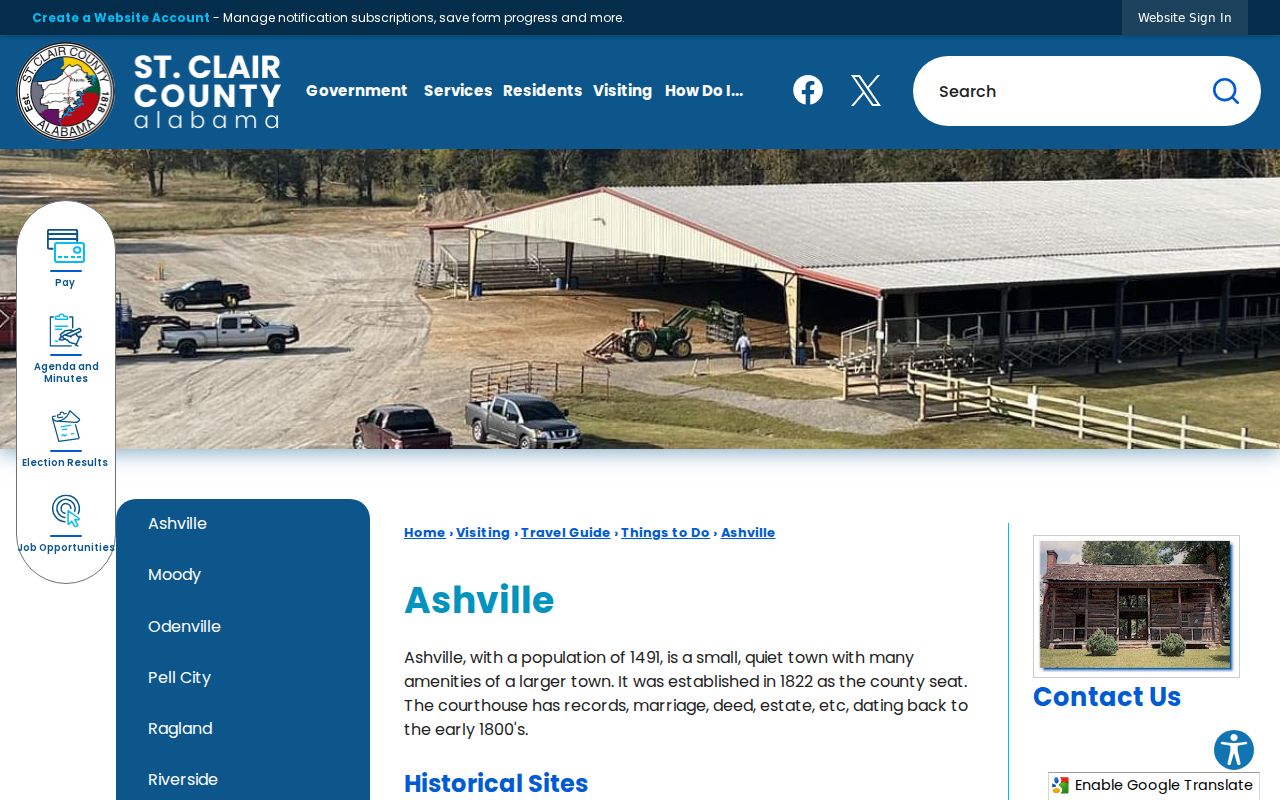
Older material may require staff help to identify the correct book, file, or storage location rather than a modern web search.
ADPH creates another useful dividing line. It keeps Alabama marriage certificates beginning in August 1936, and those certificates are unrestricted when a requester supplies enough identifying information and the required state fee. Marriage records before that date must be sought from the probate office in the county where the license was issued. That means an early St. Clair County marriage search may depend on the Ashville record history, while a later certified certificate may be ordered through the state health department or a county health department.
St. Clair Probate Court Offices
The St. Clair County Courthouse and Circuit Clerk Kathryn Burke handle Circuit and District Court files, not probate estates. Sheriff Billy Murray's office likewise keeps law-enforcement records rather than Probate Court case files.
Probate Judge Andrew Weathington leads the St. Clair County Probate Office. Both branches publish weekday service hours, but the two-site arrangement makes advance contact useful. A record may be tied to the branch where it was filed or stored. The Ashville office is near the historic county-seat courthouse campus, while the Pell City office is in the county courthouse building on Cogswell Avenue.
Probate Office, Ashville
165 5th Avenue, Suite 101
Ashville, AL 35953
205-594-2120
Monday-Friday, 8:00 a.m.-4:30 p.m.
Probate Office, Pell City
1815 Cogswell Avenue, Suite 212
Pell City, AL 35125
205-338-9449
Monday-Friday, 8:00 a.m.-4:30 p.m.
St. Clair Probate Fees
A local filing and copy fee schedule was not published in the researched official pages. Ask the St. Clair County Probate Office for the charge that applies to the exact petition, copy, or certification. The county does publish one payment cost: credit and debit card transactions at the counter or online carry a processing charge equal to 2.5 percent of the total. The Probate Office states that it does not receive that processing charge.
| Item | Published amount |
|---|---|
| Credit or debit card processing | 2.5% of the transaction |
| Estate filing | Confirm with Probate Office |
| Guardianship or conservatorship filing | Confirm with Probate Office |
| Plain or certified probate copy | Confirm with Probate Office |
This distinction matters when budgeting a filing. The card charge is not the filing fee itself, and a user should not infer an estate or copy price from it.
Notary services are another Probate Office function with a recent state change. The county notes that Alabama Act 2023-548 changed the notary public process beginning September 1, 2023. A notary question should therefore go to the Probate Office rather than the Circuit Clerk. It is also distinct from notarizing an Alabama Marriage Certificate before the completed form is delivered for recording.
What St. Clair Probate Records Show
An estate file can identify the deceased person, the petitioner, named beneficiaries, the proposed or appointed personal representative, and the judge's orders. A filed will may state the testator's wishes. Letters show that the Probate Court granted authority to an executor or administrator. Inventories, creditor notices, bonds, accountings, and final settlements can document the steps taken to collect, manage, and distribute estate property. Not every estate contains every document, and protected data may be redacted.
Guardianship and conservatorship files focus on the need for protection and the authority granted. The order matters most because it defines the guardian's or conservator's legal role. Recorded marriage certificates are a different Probate Office record. Since Alabama's 2019 change, couples complete, sign, notarize, and deliver the marriage certificate for probate recording within 30 days of the later signature. The Probate Office records it rather than issuing a marriage license. For more on the certificate and statewide copy channels, see the St. Clair County marriage and divorce records information.
Restricted St. Clair Probate Records
Open estate material should not be confused with every record associated with Probate Court. Guardianship and conservatorship proceedings may include private health, financial, and minor-related facts. Protected identifiers can be redacted. A sealed file, a protected filing, or information covered by a court order is not available through a routine public request. Ask the Probate Office what proof of identity, party status, or court authority is needed.
Adoption records receive specific protection under Alabama Code Section 26-10A-31. The official statute source shown below reinforces that adoption material does not follow the same public-access path as an ordinary estate.
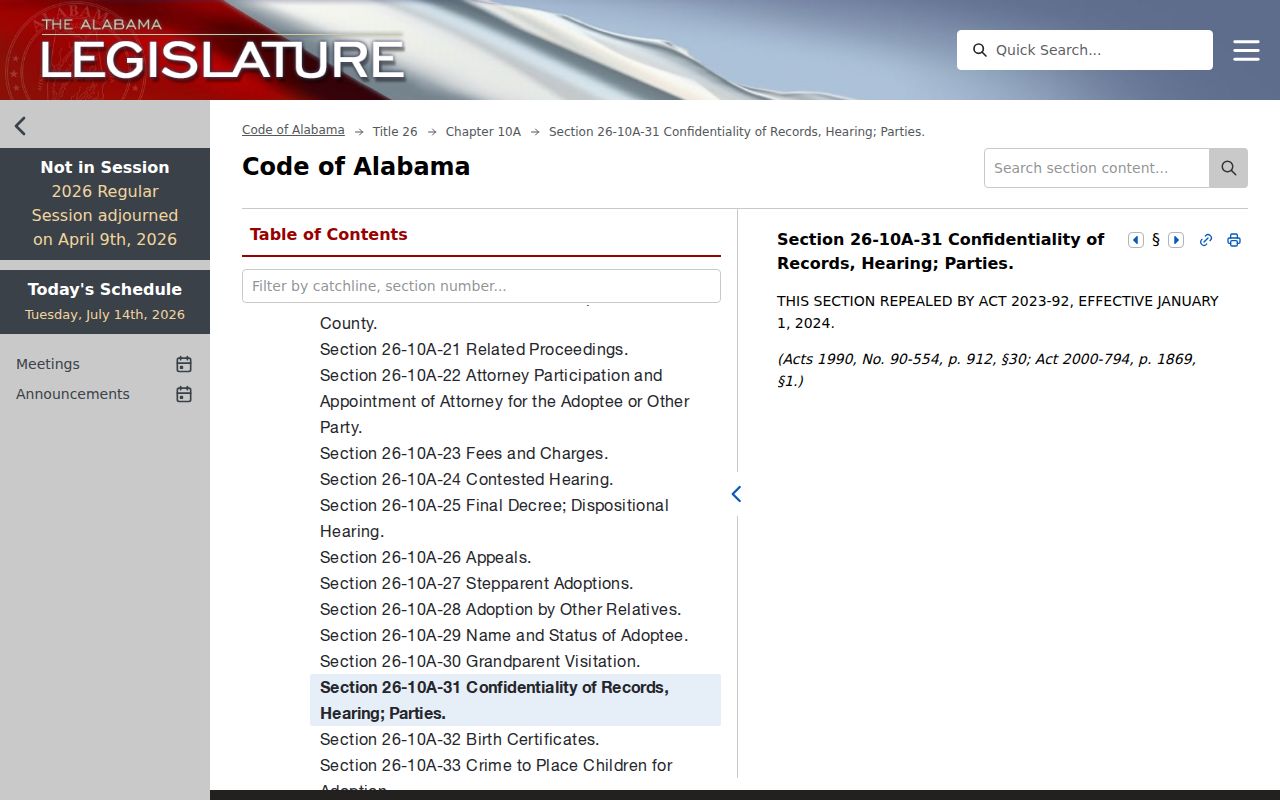
Authorized access to a restricted St. Clair County probate record depends on the law, the person's role, and any order entered in the case.
A restriction does not mean the file never exists. It means the ordinary walk-in or public-search path may not disclose it. A party, attorney, authorized agency, or person with a court order can have rights that a member of the public does not. The Probate Office can state what identification or authority must be shown, but it cannot give legal advice about how to obtain an order.